

Lure Blog #4
The great thing about lure fishing is “how portable the tackle is”. If you are traveling on business or on holiday it’s possible to take tackle and fish effectively, in both fresh and salt water. No fresh bait required no prior knowledge of the area either is necessary as lure fishing is all about “seeking, finding and catching fish”.
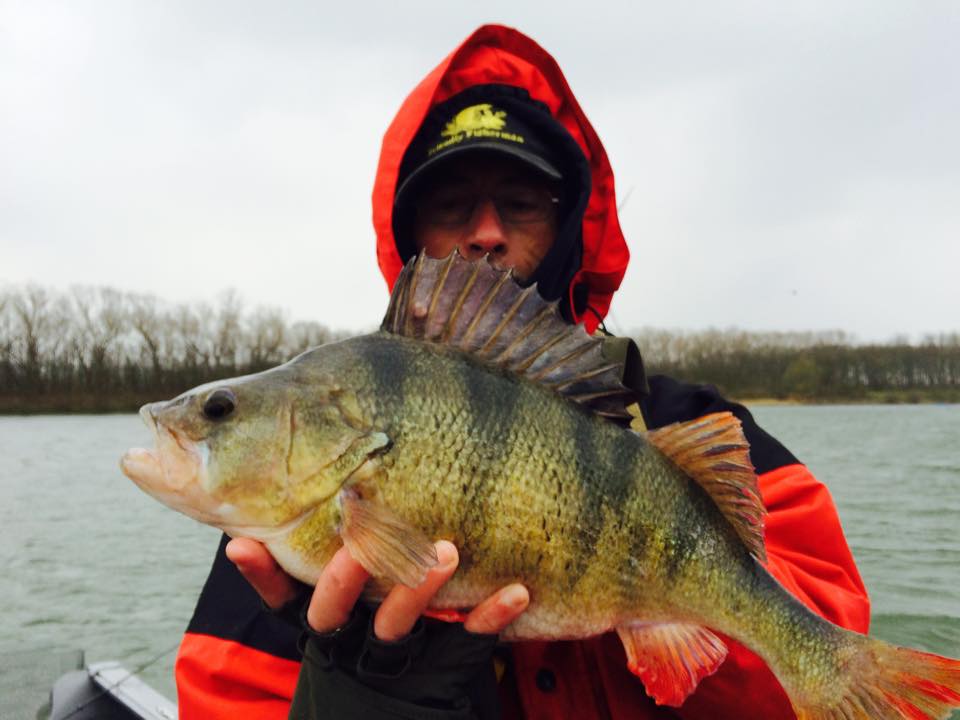
Andy’s 4lb 14oz Perch
A trip to southern Holland in search of gigantic Perch at the end of March is becoming an annual pilgrimage for my friends and me. A vast body of water known as “Hollands Diep” sees a migration of Perch arrive is this area preparing to spawn; the size of these fish is truly amazing.
Our guide was Dutch angling “ace” Willem Stolk we fished from his well-equipped boat, our days were spent casting soft plastic shads into the shallows searching the margins for pre-spawn fish or vertical jigging in the deeper water around mid-river “humps”, these humps were created from “dumped spoil” from dredging activities around the port of Rotterdam. To give you an idea of scale of this section of “river” it’s approx. 2 miles wide and 10 miles long, awesome!
As always no matter how well prepared you are the one feature you cannot control is the weather, it effects how well we are able to fish and it also effects the behaviour and location of the fish.
Our first day we headed for an area that afforded some shelter in the force 7 wind, we were fishing a gradual slope dropping into 8-10m of water, with a “hump” mid-way along the shelf being the only outstanding feature. Willem zig-zagged the boat along this shelf in an effort to locate fish, his boat has electric motors “fore and aft” which controlled our position as we drifted over the features. The change in weather had pushed most of the pre-spawn Perch off the shallows but there was always the chance of a few stragglers.
We all chose our favourite lures and commenced fishing, the first thing to establish was the right “balance” in jig head weight that allowed contact with the bottom while lifting up a matter of inches on the retrieve and allowing a “drop” on the “spin-stop”, this is when a take will occur.

A typical Zander sporting “dark” pre-spawn colours.
Over our 3 days we searched different shore line areas picking off the odd Perch to 4lb 14oz and several Zander and the occasional Pike. We did on occasion try deeper spots, “vertical” jigging but as we only caught Zander doing this we soon reverted to toughing it out in the wind casting shads.
Our trip this year coincided with a spell of cold weather that had pushed the Perch off the shallows but we persevered and on our last day my boat partner James Gardner was rewarded with 2 magnificent Perch of 5lb 1oz and 5lb 6oz.

James Gardner 5lb 6oz Perch
Bombarda Float Method
The Bombarda float in commonly used in Europe on commercial Trout fisheries and in Scandinavia where it’s used for Sea Trout and Pike, you can cast flies further and easier than on conventional fly tackle.
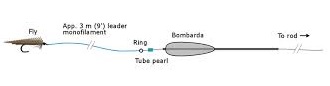
Bombard diagram
The Bombarda will look familiar to Carp anglers as it has a passing resemblance to in-line surface controllers but it differs being available in 3 densities, Floating, Intermediate and Slow Sinking. The Bombarda provides the opportunity to present flies, or “micro” soft plastics, at a controlled depth, while using spinning gear. This becomes a massive advantage when Trout are feeding on small sub-surface insects that are suspended in the water, a situation that prevents in-line Mepps style spinners from working.
I used a Bombarda while filming a segment for Sky Sports “Tight Lines” program on Bewl Water a few years ago. On that occasion I used a 3m [9ft] leader with a Damsel nymph, a long cast downwind making sure I cast high and feather the line at the end of the cast saw everything land straight avoiding tangles. I immediately noticed how much further I could cast in comparison to my fly tackle, I counted the fly down a few seconds before starting a slow retrieve. I was just wondering what a take would feel like? Suddenly I could no longer wind the reels handle as an angry Rainbow leapt clear on the water with my Damsel embedded firmly in its jaw, fish on! I’ve since read but not tried as yet that the fly can also be tied on a dropper in front of the Bombarda, thus further reducing tangles.
Another successful method using the Bombarda used by Italian Trout anglers is to thread a micro soft plastic ‘Powerbait’ grub or worm partly around the hook leaving the tail sticking out at right angles to the shank, when retrieved the bait spins around like a propeller. In this manner you can fish much slower and shallower than any spinner, give it a try when you’re next get out on Bewl or Hanningfield.
Tight lines.
Andy Lush
